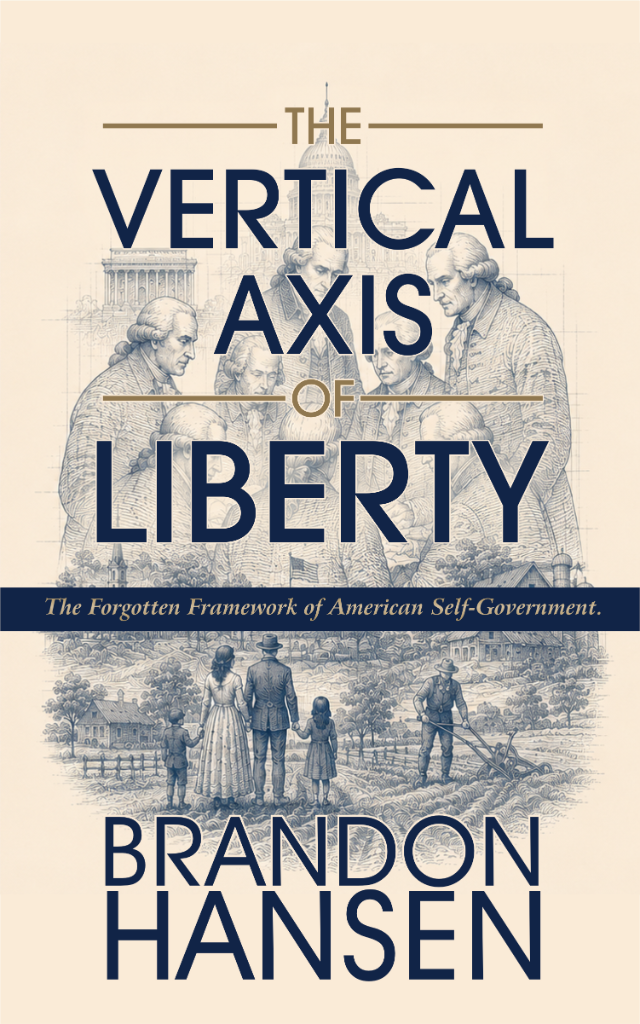
The American Experiment began with one revolutionary idea: rights belong to people, not governments.
The Central Idea
America Asked History's Most Important Political Question
For thousands of years, governments claimed that rights came from kings, rulers, or the state. America asked a different question: What if rights already belonged to every individual? That single idea transformed history. It became the foundation for self-government, constitutional government, and human flourishing.
That idea still matters today.
The Problem
Politics Was Never Meant To Be Our Entire Civic Life
"Self-government does not begin in Washington. It does not begin on television. It does not begin on social media. It begins much closer to home."
Somewhere along the way, many of us began believing that nearly every important problem had to be solved in Washington. As our attention shifted farther from our own communities, politics became louder while local citizenship became quieter.
The Founders imagined something very different.
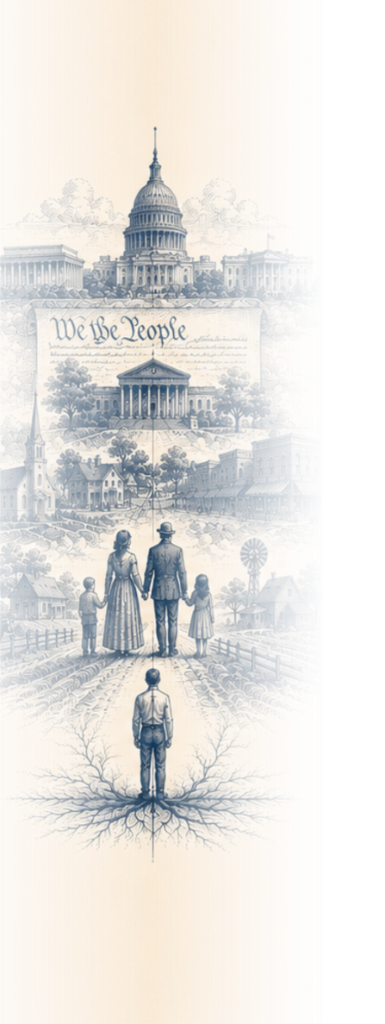
They created a constitutional republic where most decisions would remain close to the people affected by them. Families, churches, neighborhoods, towns, counties, and states would do most of the work of self-government, leaving only truly national questions to the federal government.
The farther power moves from ordinary citizens, the harder it becomes for those citizens to influence it.
The Constitution was designed to create active citizens, not passive spectators.
The Constitution was never designed to create passive spectators. It was designed to create active citizens.
The Solution
The Vertical Axis
Most political conversations happen along a horizontal axis: Left versus Right. Conservative versus Liberal. Republican versus Democrat.
This book proposes that those debates often distract us from the more important question.
The Vertical Axis asks a different question:
Does this decision move power closer to ordinary citizens, or farther away from them?
Liberty grows when decisions are made as close as possible to the people who must live with them.
Authority grows when decisions become increasingly centralized.
That single question becomes the framework through which the entire book explores American government, culture, and liberty.
The American Experiment was never built on the promise of perfect leaders. It was built on the principle of self-government.
What You'll Learn
Inside The Vertical Axis of Liberty
Discover why America's understanding of rights changed the course of history.
Understand why the Constitution created a stronger government without abandoning liberty.
Learn how federalism protects both unity and local self-government.
See why healthy families and communities are essential to a free society.
Understand the difference between persuasion and coercion.
Learn why culture shapes politics far more often than politics shapes culture.
Discover practical ways to strengthen liberty in your own family, church, neighborhood, and community.
Who This Book Is For
This book is for you if…
You believe America is still worth believing in.
You want to understand the Constitution without reading a law textbook.
You want a hopeful vision of America's future.
You believe strong families and communities matter.
You believe liberty begins close to home.
Culture ultimately shapes politics far more often than politics shapes culture.

About the Author
Meet Brandon Hansen
Brandon Hansen never intended to write a book.
Like many Americans, he spent years following elections, debates, and the daily stream of political headlines. Eventually he began asking a different question: What if the Founders expected citizens to spend less time watching Washington and more time strengthening their own communities?
That question led him back to the Declaration of Independence, the Constitution, and the Federalist Papers.
Brandon owns a sign business in rural Idaho, serves in his county Republican Party, and works with local candidates across southeastern Idaho. He lives with his wife Emily and their five children. The ideas in this book were shaped not just by studying history, but by working in his own community, where family, faith, and local self-government are part of everyday life.
Full Biography →The Constitution was never designed to create passive spectators. It was designed to create active citizens.
A Final Word
America's Brightest Days Are Ahead
Every generation inherits the American Experiment.
Every generation is responsible for preserving it.
I believe America's brightest days are ahead of us.
I believe that because the principles that gave birth to this nation are still true.
Liberty still works.
Self-government still works.
Human dignity still works.
The future of America will not be decided by spectators.
It will be built by citizens.